
For years much of the technology ecosystem focused almost exclusively on English-language markets even though Artificial Intelligence is making industries across the world dynamic. Even when there was a global attempt by companies to build larger models with more powerful systems, one critical challenge remained unsolved: creating AI that truly understands Arabic language, culture, and context.
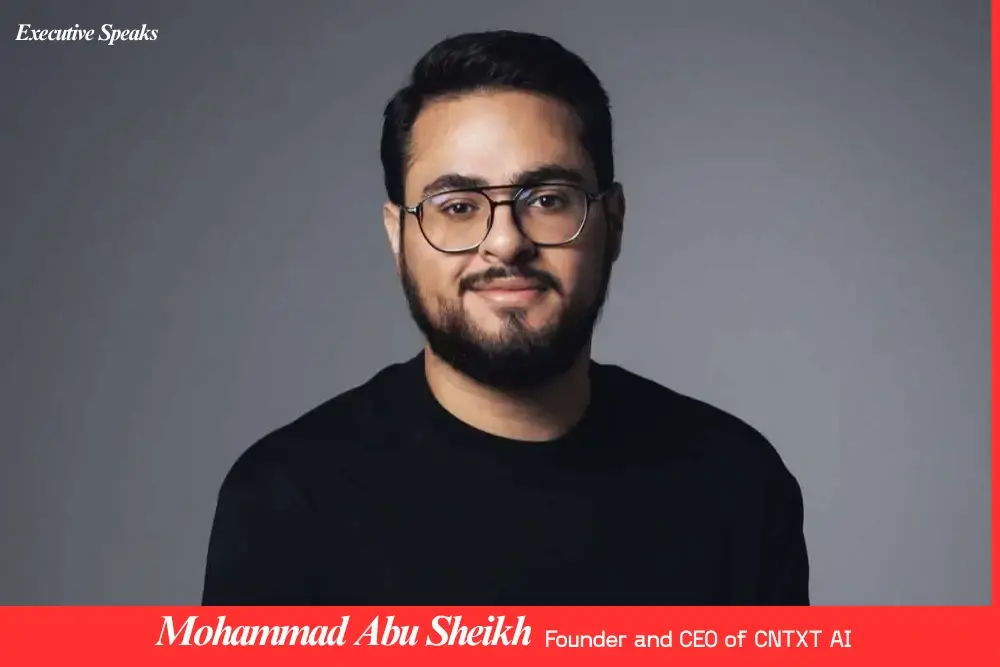
The entrepreneur Mohammad Abu Sheikh, Founder and CEO of CNTXT AI, took that challenge as an opportunity to grow and be unique in the industry.
Abu Sheik has previously attempted several ventures across education, media, and technology, spending much of his career identifying gaps that others often missed. His latest venture, CNTXT AI, was an attempt to solve the most crucial issue within the AI industry; developing sovereign AI systems which are culturally intelligent and designed specifically for Arabic-speaking communities.
From Local Problems to Regional Solutions
In all the businesses that Abu Sheikh founded he followed a common philosophy; build solutions for problems that are visible. He did not believe in businesses that build solutions aimed at imported answers that are designed by someone, somewhere. This is because he had a clear vision on what makes a good leader.
His initial projects were started out of his frustrations, exposing larger gaps such as outdated educational systems with immense struggle with data management and minimal accessibility to digital content in Arabic language. Those experiences repeatedly exposed a larger issue: tech build for English speakers rarely was found effective for Arabic speakers.
As digital transformation accelerated across the Middle East, the need for Arabic-first AI became apparent. Organizations across the region welcomed artificial intelligence, however, the foundational infrastructure necessary to support Arabic language systems that existed was still not developed to meet the requirements. This realization eventually led to the creation of CNTXT AI, by Mohammed Abu Sheikh.
How Being Early can be a Strategic Advantage
Abu Sheikh and his teams started working with Arabic language technologies, automation systems, and data infrastructure way before generative AI became popular across the world. This early start forced the organization to solve problems which were not a popular discussion in the global markets.
While many organizations today depend heavily on third-party AI providers, CNTXT AI has invested in controlling much of its technology stack. This strategy gave the company the potential to be more flexible in their functioning and greater control over managing data. Besides, they also developed the ability to adapt solutions specifically for the government and enterprise customers across the Middle East.
Apart from these benefits, being the forerunners also gave them the capacity to develop expertise which many either would take time to achieve in the industry. It would normally take years of consistent effort to build high-quality datasets and create testing environments, and language-specific validation systems.
As the market increasingly recognizes the importance of localized AI, those early investments have become a competitive advantage for CNTXT AI.
The Rise of Sovereign AI
One of the most important conversations happening in artificial intelligence today is about the significance of sovereignty.
Governments and enterprises are becoming well aware of the risks associated with completely depending on external tech-providers for critical infrastructure and sensitive data.
This concept was revolutionized by For Abu Sheikh, where his idea of sovereign AI was far more than local data centers. True sovereignty means maintaining control over data, where systems could be trained with information relevant to regions. Further it should also ensure that organizations retain ownership of the technologies that shape their future.
This approach has become especially relevant across the Gulf region, where governments are investing heavily in economic transformation based on AI.
By combining regional expertise with partnerships across cloud infrastructure and advanced computing ecosystems, CNTXT AI is positioning itself as a key player in this emerging landscape.
How Arabic AI Impacted Industries
Several sectors were positively impacted by the application of Arabic AI.
In education, students can interact with intelligent systems using their natural dialects instead of shifting their communication based on technology. Several areas could experience more clarity as in media, content creation, transcription, and translation accuracy and cultural relevance became easier requirements to meet.
In addition, government agencies can improve services provided to their citizens such as healthcare automation through AI-powered interactions. It could better understand local language patterns and expectations. It became possible for enterprises to deploy intelligent systems that communicate effectively with employees, customers, and stakeholders throughout the region.
These possibilities got further expanded with the initiation of robotics and physical AI. It allowed Arabic-speaking operators to interact naturally with sophisticated machines and systems which were automated.
As adoption accelerates, organizations that invest early in these capabilities may gain substantial competitive advantages.
Frequently Added Questions
1. Who is Mohammad Abu Sheikh?
Mohammad Abu Sheikh is the Founder and CEO of CNTXT AI, a company focused on Arabic AI and sovereign technology solutions.
2. What is CNTXT AI?
CNTXT AI develops Arabic-first AI systems, data solutions, and AI infrastructure for organizations across the Middle East.
3. What makes Arabic AI unique?
Arabic AI must handle multiple dialects, complex language structures, and cultural context.
4. What is sovereign AI?
Sovereign AI allows organizations to keep control of their data, infrastructure, and AI systems.
5. Why is Arabic AI important?
It helps businesses, governments, and individuals access AI that better understands Arabic language and culture.