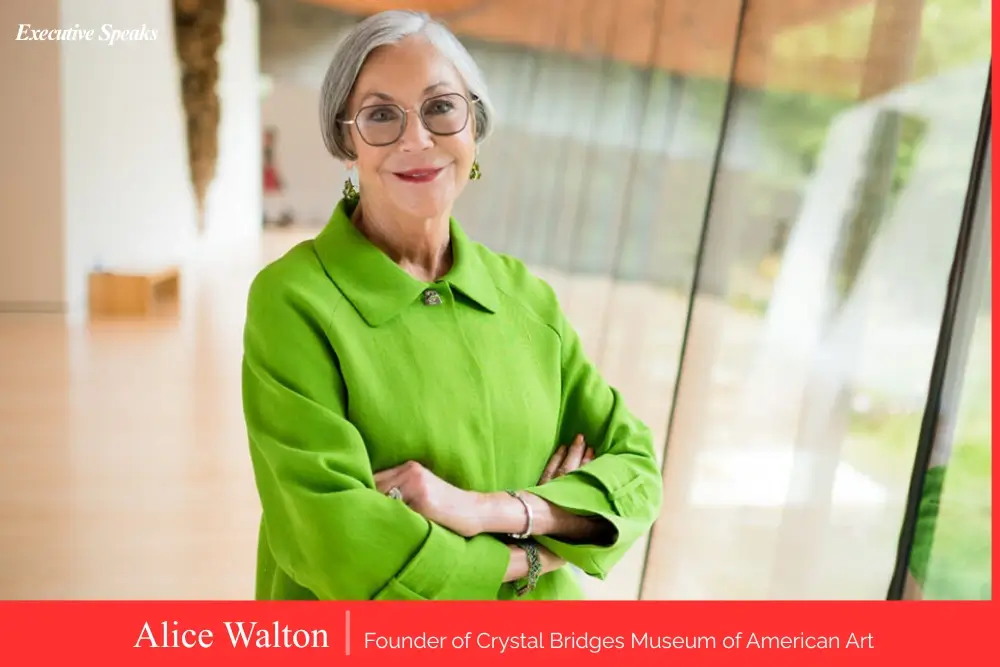
The name Alice Walton, is often remembered with Walmart, one of the largest retail companies around the globe. However, she chose a different path in comparison to the other heirs of the Walton family, as she was dedicated to creating a legacy for herself.
Alice Walton did not express interest in corporate leadership, instead she was into art, education and healthcare. This was primarily because she believed that more than the corporate world, these can transform human lives for the betterment of the society.
This thought and her unmatched efforts made her one of the most influential philanthropic leaders of her generation and not only the wealthiest women in the world. The story of Alice Walton demonstrates how to think like a CEO and how wealth can be used not merely to build businesses but to create opportunities that can consistently benefit society for decades.
What is the Early Life of Alice Walton
Alice Walton was born in 1949 as the daughter of Sam Walton, the founder of Walmart.
From her early childhood she witnessed how entrepreneurship and executive mindset functions. She evidenced how a small enterprise can be transformed into an international business through strong leadership skills and long-term vision. Even though Alice Walton lived through a retail family, her dreams and aspirations were far beyond retail business.
She remained a fan of creativity and culture from an early age. It was evident in her later works which were modelled on the family trips and outdoor adventures she experienced throughout her life, which depicts her curiosity for art. Unlike some members of business dynasties who follow established corporate paths, Walton pursued her own vision of impact.
Creating Crystal Bridges Museum
In 2011, Alice Walton opened the Crystal Bridges Museum of American Art in Bentonville, Arkansas.
It was not long or difficult for the Museum to transform into one of the most crucial cultural institutions in the United States of America. The Museum featured the works of several celebrated artists like Norman Rockwell and Edwin Hopper, celebrated American artists across multiple generations. Thus, the Crystal Bridges attracted visitors from around the world in minimal time since inception.
The key factor that differentiates the museum is how committed it remains in terms of accessibility. Alice Walton believed that every individual should have accessibility to art, irrespective of their financial position.
In addition, the museum has also contributed to the development of the economy, promoted tourism along with enhancing the engagement of communities throughout its existence.
Why is the Museum Called Crystal Bridges?
The name "Crystal Bridges" reflects both the museum's architectural design and its mission. The museum features a series of bridge-like structures that span natural ponds and landscapes in Bentonville, Arkansas. Designed to blend art, architecture, and nature, the bridges are a defining feature of the campus.
Crystal Bridges created a cultural destination, however, the goal Walton had in mind was to expand the reach of American art even further across the globe.
To achieve this goal, she established the Art Bridges Foundation.
The goal of the foundation was to collaborate museums across the United States which would help in increasing public access to important works of art. By supporting exhibitions, loans, and partnerships, Art Bridges helps connect communities with cultural experiences that may otherwise remain inaccessible.
Alice Walton's philosophy is what is evident here that art should not remain hidden in storage rooms but should be shared with the public whenever possible.
Investing in Education
Alice Walton's philanthropic vision did not remain restricted to arts.
She has consistently supported educational initiatives as she always envisioned supporting students. Besides, she also created several opportunities for educators and future leaders. Alice Walton shared and articulated her visions through her charitable foundations and partnerships. Her contribution to programs designed to improve learning outcomes and strengthen communities have received wide acclaim. One notable example is her formation of the Alice Walton School of Medicine, where the prime focus was to train future physicians in combining traditional medicine and whole health principles.
Walton believed that long-term investments matter more when compared to short-term solutions as they can generate consistent growth in an individual or for organizations. Hence, she focused on projects that are capable of generating social impacts that endure.
This commitment to education reflects her belief that knowledge remains one of the most powerful tools for improving lives.
What Alice Walton Learned About Healthcare
Alice Walton started several healthcare initiatives recently as she wished to reimagine the healthcare industry for the betterment of humanity.
She recognized that the healthcare industry was in need of giving more focus on wellness than on the traditional aspects. With this view, Walton supported efforts that integrate physical, mental, and emotional wellness.
Her work in this area reflects a broader understanding of healthcare—one that focuses not only on treating illness but also on promoting overall well-being.
Through new institutions and partnerships, she has encouraged conversations about how healthcare systems can better serve individuals and communities.
Frequently Asked Questions
Who is Alice Walton?
Alice Walton is a philanthropist, art patron, and member of the Walton family, founders of Walmart.
Why is Alice Walton famous?
She is known for her philanthropic work in art, education, and healthcare.
What is Crystal Bridges Museum?
Crystal Bridges is a major American art museum founded by Alice Walton in Arkansas.
What is the Art Bridges Foundation?
It is an organization that helps expand public access to American art across the United States.
How does Alice Walton support healthcare?
She has funded initiatives focused on improving access to holistic and community-based healthcare.
What is Alice Walton's legacy?
Her legacy centers on expanding access to art, education, and healthcare through long-term philanthropic investments.